As more clinics turn to Remote Patient Monitoring (RPM) to manage chronic conditions, the market is expanding rapidly. According to a 2024 McKinsey report, over 70% of healthcare providers plan to expand or launch RPM programs within the next two years.
That growth also means more vendors to choose from — but not all are built to last. Some focus only on short-term device delivery, while others offer the full ecosystem: patient engagement tools, EHR integrations, billing support, and data-driven insights.
This blog breaks down how to choose an RPM vendor for long-term success. By the end, you’ll know how to:
- Identify your clinic’s RPM goals and patient needs.
- Evaluate vendor technology, pricing, and compliance.
- Choose a partner who can grow with your practice for years to come.
Let’s start with the basics, what makes an RPM vendor the right one for sustainable success?
How to Choose an RPM Vendor for Long-Term Success
Choose a vendor whose
- technology integrates easily with your existing systems,
- supports scalable care models,
- prioritises patient engagement and security,
- offers transparent pricing and reimbursement support,
- and complements your care strategy over years rather than just months.
Here’s a quick formula to remember:
Right Vendor = Seamless Tech + Patient Engagement + Transparent Pricing + Compliance + Long-Term Partnership.
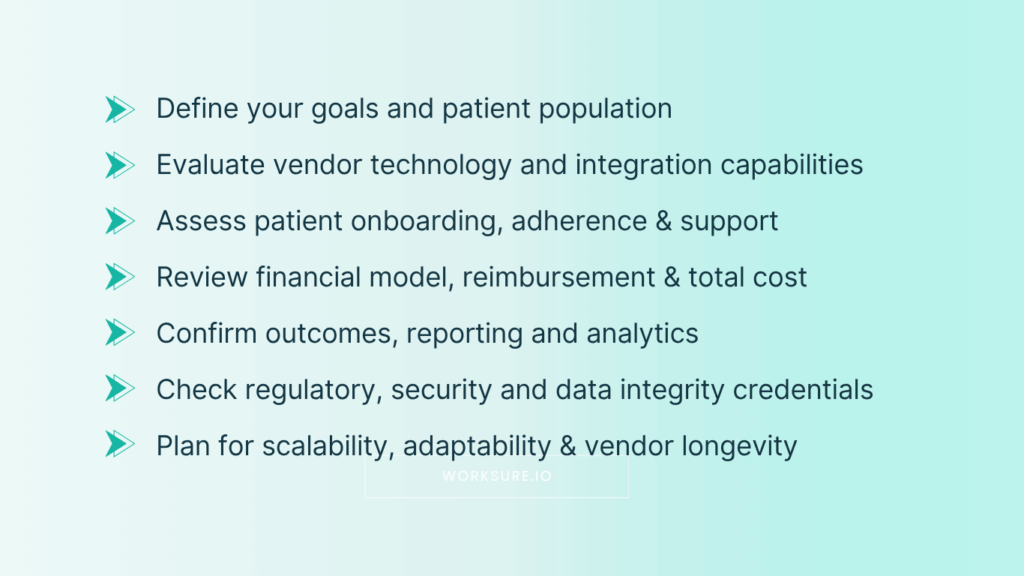
Here are the steps to choose the right RPM vendor for long-term success:
- Define your goals and patient population
- Evaluate vendor technology and integration capabilities
- Assess patient onboarding, adherence & support
- Review financial model, reimbursement & total cost
- Confirm outcomes, reporting and analytics
- Check regulatory, security and data integrity credentials
- Plan for scalability, adaptability & vendor longevity
The table below helps you compare vendors side by side based on these steps.
| Evaluation Area | What to Look For | Why It Matters | CandiHealth Advantage |
| Technology Fit | Seamless EHR integration, easy-to-use dashboard | Reduces staff workload and avoids duplicate entries | Built for plug-and-play setup with zero-code integration |
| Device Flexibility | Works with multiple RPM devices (BP, glucose, weight, pulse ox) | Supports future expansion without switching vendors | Offers cellular BP devices pre-configured for instant use |
| Patient Support | Simple onboarding and ongoing engagement | Ensures patients stay compliant and consistent | Handles setup, reminders, and multilingual support |
| Pricing Model | Transparent, flat monthly rate | Prevents billing surprises and supports scalability | Flat-rate pricing per patient, no revenue share |
| Compliance & Security | HIPAA compliance, secure data storage, 99.9% uptime | Protects patient data and maintains Medicare eligibility | Fully HIPAA-compliant with encrypted data transmission |
| Reporting & ROI | Clear analytics, CPT tracking, performance metrics | Helps prove financial and clinical outcomes | Auto-tracks CPT codes and displays live ROI dashboards |
| Scalability & Longevity | Vendor stability, regular updates, responsive support | Ensures the platform grows with your practice | Backed by a long-term product roadmap and local support team |
Here is the detailed overview of each step.
1. Define Your Goals and Patient Population
Before choosing a vendor, be clear about what you want to achieve. Without defined goals, even the best RPM platform won’t bring lasting results. Ask simple questions:
- What do you want RPM to solve — fewer readmissions, better chronic care, or more revenue?
- Do you need help with billing, patient follow-up, or workflow efficiency?
Your answers will guide which vendor fits best. For example, a clinic focused on reducing readmissions should choose a vendor with real-time alerts and care coordination tools. If your goal is chronic care, look for long-term tracking and patient reminders.
Know Your Patient Type
Decide who you’ll monitor:
- Chronic patients like those with hypertension or diabetes.
- Recently discharged patients.
- Elderly or rural patients with limited tech access.
If you serve seniors or remote areas, a cellular-based RPM vendor like CandiHealth works better than app-based systems since no Wi-Fi or smartphone is needed.
2. Evaluate Vendor Technology and Integration Capabilities
Once your goals are clear, the next step is to check how well a vendor’s technology fits into your existing setup.
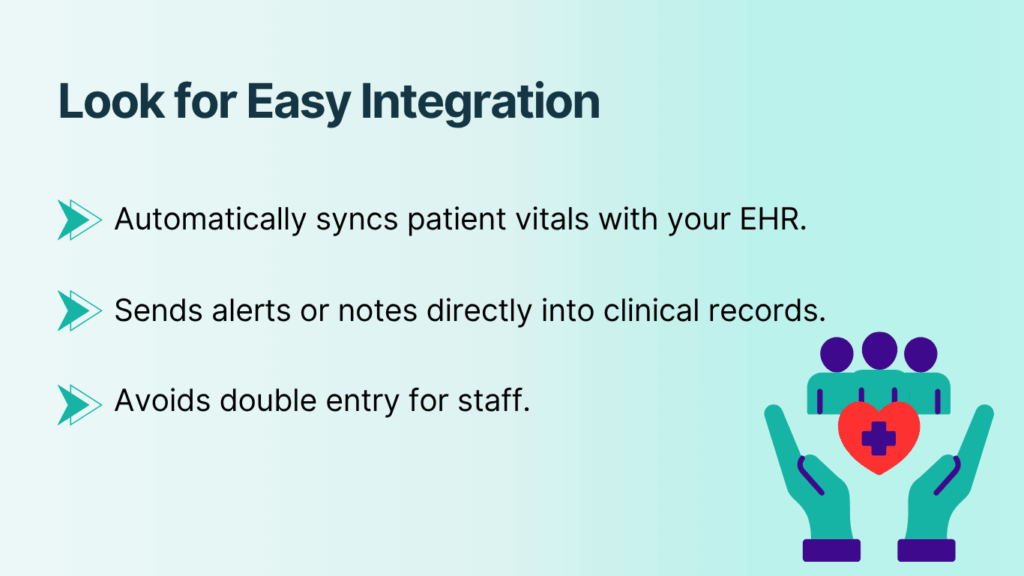
Look for Easy Integration
Your RPM platform should connect smoothly with your existing EHR or EMR system.
Ask vendors if their platform:
- Automatically syncs patient vitals with your EHR.
- Sends alerts or notes directly into clinical records.
- Avoids double entry for staff.
If integration is complex, your team may waste hours switching between tools — and that slows care delivery.
Check Device Compatibility
The best vendors support multiple device types — blood pressure monitors, glucose meters, pulse oximeters, and weight scales. Avoid vendors locked to a single brand or model. Flexibility ensures you can expand your program without replacing your entire setup later.
Prioritize Ease of Use
Technology should simplify care, not complicate it. Choose a platform with:
- A clean, intuitive dashboard for staff.
- Automatic data uploads for patients.
- Simple alerts that don’t overwhelm your team.
If staff find the system hard to use, patient adherence will drop — no matter how good the devices are.
3. Assess Patient Onboarding, Engagement, and Support
Even the most advanced RPM platform won’t succeed if patients don’t use it. The true test of a vendor lies not in their technology, but in how well they help patients get started, and stay consistent.
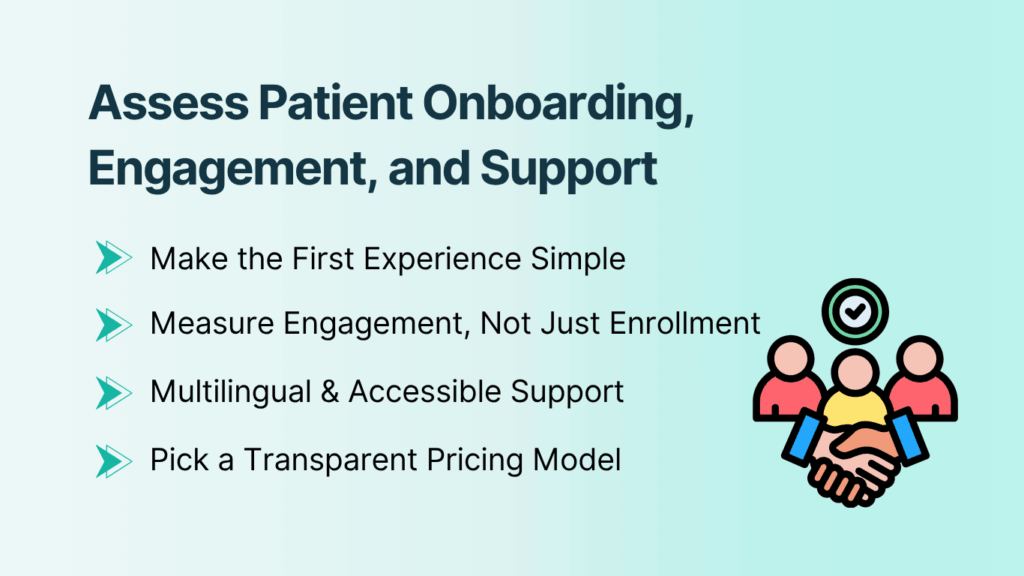
Make the First Experience Simple
The onboarding process should feel effortless. A good vendor guides patients from device delivery to setup without confusion. Ask:
- Do they preconfigure devices before shipping?
- Is the setup “plug and play,” or do patients need technical help?
- Can the vendor assist non-tech-savvy users remotely?
Measure Engagement, Not Just Enrollment
Getting patients enrolled is easy; keeping them engaged is harder. The best vendors use reminders, check-ins, and automatic alerts to keep patients consistent.
For example, vendors that send gentle text reminders for missing readings often see 20–30% higher adherence rates compared to those that don’t. Look for vendors who share engagement metrics like:
- Daily/weekly reading submission rates.
- Average adherence per patient.
- Percentage of patients active after 3 months.
Multilingual & Accessible Support
Healthcare doesn’t end at language barriers. Your vendor should offer multilingual support, especially if your patient base includes diverse communities. Also check if they provide:
- 24/7 helpline or chat support.
- Written or video instructions for patients with limited literacy.
- Localized educational materials.
- Provide staff onboarding sessions.
- Have clear escalation processes for tech issues.
4. Review Pricing, Reimbursement, and ROI
Pricing decides how sustainable your RPM program will be. A good vendor makes costs clear and billing simple.
Pick a Transparent Pricing Model
Avoid surprises later. Flat-rate pricing per patient is the most predictable — you know what you’ll pay each month. Revenue-share models may look cheaper at first but usually cost more as your patient count grows.
Check Reimbursement Support
Ask how the vendor helps with Medicare CPT codes (99453, 99454, 99457, 99458).
The right vendor should track time automatically for each code, provide ready-to-bill reports and reduce claim errors. When comparing vendors, use this quick cost-benefit matrix:
| Factor | What to Ask | Ideal Response |
| Pricing model | Is pricing flat-rate or revenue-share? | Flat-rate per patient |
| Billing support | Do you help with CPT code tracking? | Yes, automated logs |
| Long-term savings | Any hidden fees or penalties? | None |
5. Verify Outcomes, Reporting, and Analytics
Data tells the real story of your RPM program. A reliable vendor won’t just collect patient readings — they’ll turn them into insights your team can act on. Ask vendors:
- Can we view trends by condition or patient group?
- Do reports show early warning signs for high-risk patients?
- Can outcomes be exported for audits or leadership reviews?
If the reports only show raw data, you’ll spend hours finding meaning instead of improving care. You should be able to spot:
- Which patients need attention today.
- How your clinic’s average readings are trending.
- How much time staff spent on monitoring (for billing proof).
This level of visibility helps you plan better and keep your program compliant.
6. Check Regulatory Compliance, Data Security, and Reliability
Every RPM vendor promises “HIPAA compliance,” but not all can prove it. Before you sign, ask to see their credentials — data encryption details, audit certificates, and uptime records. A truly compliant vendor should:
- Encrypt all data in transit and at rest.
- Store data on secure, region-based servers.
- Log access history and maintain audit trails.
- Offer disaster-recovery backups for continuity.
7. Plan for Scalability and Vendor Longevity
When you’re choosing a vendor, think long-term. Does their platform update regularly, or does it feel outdated after six months? Do they continue adding features that match evolving care models? A forward-thinking vendor invests in product development as much as you invest in patient care.
Strong partnerships are built on transparency and innovation. Your vendor should act like an extension of your care team — offering updates, training, and support as your RPM goals expand. When they grow with you, rather than around you, that’s when true scalability happens.
In the end, the best vendors don’t just sell technology. They evolve alongside your practice, ensuring your RPM program never outgrows its foundation. Longevity is not about promises; it’s about proof — consistent support, timely updates, and a shared vision for better patient outcomes.
Final Thoughts
Long-term success in Remote Patient Monitoring comes from vendors who deliver on three things: reliability, transparency, and patient-centered design.
When selecting a vendor, think beyond features. Look for a team that aligns with your mission, adapts to your growth, and keeps compliance at the core of every process. A truly dependable partner evolves with you as healthcare and reimbursement models change.
At CandiHealth, we’ve built our platform around that principle. With flat-rate pricing, cellular BP devices that work without Wi-Fi or apps, and a Medicare-compliant workflow, we make RPM easy to launch and effortless to maintain. Clinics that choose CandiHealth gain a long-term partner focused on improving patient outcomes and financial stability.
If you’re ready to grow your RPM program with a trusted partner, schedule a quick demo today and see how CandiHealth helps clinics achieve long-term success, one patient at a time.
Frequently Asked Questions
What is the most important factor when choosing an RPM vendor?
The most important factor is how well the vendor’s platform integrates with your clinic’s workflow. Seamless integration ensures data accuracy, simplifies billing, and saves staff time — all of which directly impact long-term RPM success.
What is one of the main challenges of RPM?
The biggest challenge in Remote Patient Monitoring is keeping patients consistently engaged. Without clear onboarding, reminders, and support, adherence drops quickly — making even the best technology ineffective. Choosing a vendor with strong patient engagement tools helps overcome this barrier.
What are the disadvantages of RPM?
RPM’s main drawbacks include upfront costs, training needs, and occasional data gaps when patients forget readings. However, these challenges can be reduced by selecting a vendor that automates reminders, provides support, and offers simple cellular devices instead of Wi-Fi-dependent tools.
How to start an RPM business?
To start an RPM business, define your target conditions, choose a compliant vendor, set up billing workflows, and train staff for patient onboarding. Ensure your program aligns with Medicare CPT codes (99453–99458) for proper reimbursement and sustainable revenue.
What is RPM in pharma sales?
In pharma, Remote Patient Monitoring helps track real-world treatment outcomes. It provides data on medication effectiveness, adherence, and patient progress. This allows pharmaceutical teams to support physicians better and make evidence-based marketing or research decisions.