Remote Patient Monitoring (RPM) is becoming one of the simplest ways for clinics and entrepreneurs to grow in healthcare. It allows doctors to track patients’ vital signs from home using connected devices and get reimbursed by Medicare for that care.
Starting an RPM business doesn’t require a large setup or heavy investment. You just need the right technology, workflow, and compliance steps. With the right plan, you can launch your RPM program, onboard patients quickly, and build a steady monthly revenue stream while improving patient outcomes.
This guide explains exactly how to start a remote patient monitoring business.
What Is Remote Patient Monitoring?
Remote Patient Monitoring (RPM) is a healthcare service that tracks a patient’s vital readings using connected devices from their home. The readings are sent automatically to the provider’s dashboard, where doctors can review them and act if anything looks abnormal.
It helps clinics manage chronic diseases such as hypertension and diabetes without frequent in-person visits. According to the American Medical Association (AMA 2024 Digital Health Study), over 88% of healthcare professionals believe remote monitoring improves patient outcomes and strengthens long-term engagement.
How to Start a Remote Patient Monitoring Business?
To start a remote patient monitoring business, you need to follow these steps:
- Understand the market opportunity
- Define your business model
- Select a technology partner
- Get clinical and billing compliance right
- Set up workflows
- Onboard providers and patients
- Build partnerships and market your RPM service
- Measure and scale
Each of these steps will help you build a sustainable, compliant, and revenue-generating RPM business. Here is the detailed overview.
Step 1: Understand the RPM Market Opportunity
The Remote Patient Monitoring (RPM) industry is one of the fastest-growing areas in U.S. healthcare. According to Grand View Research (2024), the RPM market in the U.S. crossed $1.2 billion and is projected to grow by 18% every year through 2030.
The reason is simple: over 130 million Americans live with chronic conditions that need regular monitoring, but clinics often lack the time and tools to manage them between visits.
This gap has opened doors for entrepreneurs to launch RPM companies that offer ready-made solutions to healthcare providers. It’s a recurring revenue model that scales with every enrolled patient.
Step 2: Define Your Business Model
Before launching your RPM business, you need to decide how you’ll operate. The right model depends on your goals, available resources, and whether you’re a clinic, entrepreneur, or healthcare startup. Here are the three main models you can choose from:
| Model Type | How It Works | Best For |
| Clinic-Owned RPM Program | The clinic runs its own RPM service, purchases or rents devices, and manages everything in-house. | Established practices with staff to handle monitoring. |
| RPM Service Provider | You build and run RPM services for multiple clinics or independent providers, offering setup, monitoring, and reporting. | Entrepreneurs or telehealth startups. |
| Hybrid Model | A mix of in-house and vendor-managed operations. You handle patient relationships, while the vendor manages devices and software. | Small to mid-sized clinics wanting shared control. |
Each model has its pros and cons. Clinic-owned programs offer full control but require internal staff. Service providers scale faster but depend on multiple clients. Hybrid setups balance both, letting you focus on patient care while your vendor handles the tech.
Tip: If you want to minimize upfront costs, consider a flat-fee RPM vendor like CandiHealth. You don’t have to buy devices or share revenue, just pay a fixed monthly fee per patient, and start earning from the first month.
Step 3: Select an RPM Technology Partner
Your technology partner is the foundation of your RPM business. A reliable platform simplifies patient onboarding, data collection, compliance, and billing, all while saving time for your clinical staff. When choosing an RPM vendor, look for these essentials:
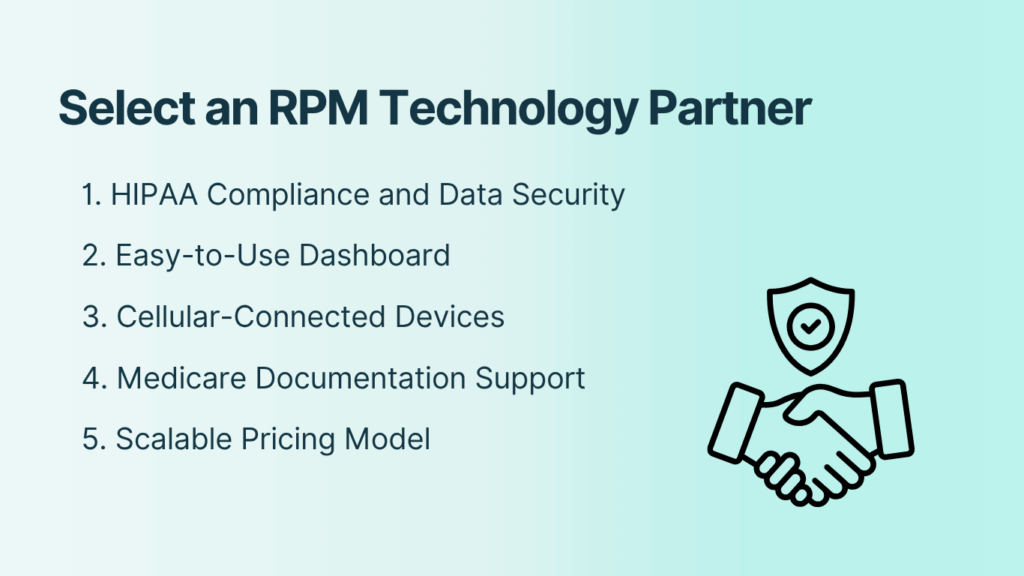
1. HIPAA Compliance and Data Security
The system must meet HIPAA and CMS standards to protect patient data. Verify that all transmissions are encrypted and stored securely.
2. Easy-to-Use Dashboard
Your staff should be able to track readings, alerts, and patient engagement in one place. A good dashboard should show trends, not just numbers.
3. Cellular-Connected Devices
Patients shouldn’t need Wi-Fi or apps. Devices with built-in cellular connectivity send readings automatically, reducing setup issues and dropout rates.
4. Medicare Documentation Support
Choose a platform that logs time, captures consent, and generates monthly reports to support CPT code billing. This ensures you stay compliant with Medicare requirements.
5. Scalable Pricing Model
Avoid vendors that take a revenue share or charge per feature. A flat-fee model keeps costs predictable as you scale.
Step 4: Get Clinical and Billing Compliance Right
Running an RPM business means working within Medicare’s billing and documentation guidelines. Understanding these rules from the start helps you stay compliant and avoid claim denials. Here’s what you need to know:
1. Required CPT Codes for RPM
Medicare recognizes five main codes for RPM. Each covers a different part of the service:
| CPT Code | Description | Approx. Reimbursement |
| 99453 | Initial device setup and patient education | ~$19 one-time |
| 99454 | Device supply and data transmission (per month) | ~$43/month |
| 99457 | First 20 minutes of monitoring and communication | ~$47/month |
| 99458 | Each additional 20 minutes | ~$38/month |
| 99091 | Data interpretation by a physician (optional) | ~$56/month |
Note: Rates vary by location and payer but align closely with CMS national averages.
2. Documentation You Must Maintain
Medicare requires clear proof that the service is medically necessary and properly tracked. You’ll need:
- Patient consent (verbal or written).
- Device usage logs showing at least 16 days of data in a 30-day period.
- Time logs showing staff communication and monitoring activity.
- Clinical notes summarizing actions taken based on readings.
Pro Tip: Always assign a team member or nurse to oversee RPM documentation and ensure all logs are entered before billing each month.
Step 5: Build Your Operational Workflow
Once your tech and compliance setup are ready, focus on operations. Your RPM business needs a repeatable system for enrolling clinics, activating patients, and maintaining consistent service quality. Here’s a simple operations blueprint:
Team Structure
| Role | Responsibility |
| Account Manager | Manage clinic relationships and contracts |
| RPM Nurse or Monitoring Staff | Review alerts and daily readings |
| Billing Specialist | Ensure correct CPT submissions |
| Operations Lead | Oversee device logistics and reporting |
| Tech Partner (like CandiHealth) | Provide platform, compliance tools, and analytics |
Process Flow
- Sign contracts with partner clinics.
- Onboard them to your RPM platform.
- Ship preconfigured devices to patient addresses (or drop-ship through vendor).
- Monitor readings and generate monthly reports.
- Send billing summaries to clinics for submission.
This structure lets you scale without needing a large in-house team. You handle logistics, data, and compliance, while clinics deliver the care.
Step 6: Onboard Clinics and Build Partnerships
Once your RPM operations are ready, your next step is to sign your first client clinics. This is where your business shifts from setup to revenue.
1. Identify Ideal Clinic Partners
Target small and mid-sized primary care clinics, internal medicine practices, and community health centers. These clinics often want to offer RPM but lack staff, time, or infrastructure. Focus on clinics that:
- Serve a high number of hypertension or diabetes patients.
- Have fewer than 10 physicians.
- Are already billing Medicare or chronic care codes.
Tip: Use tools like Apollo.io or LinkedIn Sales Navigator to find clinics by location, specialty, and size.
2. Create a Clear Value Proposition
Your pitch should focus on revenue growth, patient outcomes and effort reduction. Example talking points:
- You can earn $100+ per patient per month with RPM.
- Our team manages everything: device setup, alerts, and reporting.
- You only review reports and bills under your NPI, we handle the rest.
Focus on business outcomes: higher revenue, compliance peace of mind, and better patient retention.
Step 7: Measure and Scale Your RPM Business
Once your first few clinics are onboard, shift your focus from setup to growth. Scaling an RPM business requires tracking key metrics, refining processes, and expanding partnerships, all while maintaining compliance.
To understand how your RPM business is performing, monitor these numbers monthly:
| KPI | What It Tells You | Goal |
| Active Clinics | Number of partner clinics using your service | +10–15% monthly growth |
| Patients Enrolled | Volume of patients monitored through your platform | Steady month-over-month increase |
| Revenue per Clinic | Average monthly income per clinic | Maintain consistency or improve |
| Churn Rate | Clinics leaving your service | Keep below 5% |
| Compliance Rate | % of patients meeting CMS data requirements | 95%+ for billing success |
Tracking these metrics helps you spot bottlenecks early, whether in sales, onboarding, or billing performance.
Once your model works in one region, expand strategically:
- Regionally: Target nearby states or metro areas with similar reimbursement rates.
- Vertically: Add related services like Chronic Care Management (CCM) or Remote Therapeutic Monitoring (RTM).
This diversification increases your average revenue per client while leveraging the same infrastructure.
Final Thoughts
Starting a remote patient monitoring business is a powerful opportunity for entrepreneurs who want to enter healthcare with a scalable, recurring-revenue model. Success depends on choosing the right technology, staying compliant, and building strong relationships with clinics that trust you to handle the operational side.
With the right systems in place, one contract can quickly grow into ten, and each clinic can add hundreds of patients to your platform.
Frequently Asked Questions (FAQs)
1. What are the requirements for RPM?
To start a remote patient monitoring business, you need:
- A HIPAA-compliant RPM platform.
- Connected devices (e.g., cellular BP monitors, glucose meters).
- Clinical staff or partnerships to monitor readings.
- CPT billing workflow compliant with CMS (99453–99458).
- Business Associate Agreements (BAA) with partner clinics.
2. What tech is used in RPM?
RPM businesses rely on three core technology layers:
| Category | Examples | Purpose |
| Connected Devices | BP monitors, glucose meters, pulse oximeters | Capture real-time health data |
| RPM Software Platform | CandiHealth, Optimize Health, Prevounce | Store, analyze, and transmit readings securely |
| Communication Tools | Dashboards, alerts, patient portals | Allow providers to respond and document interactions |
3. Is remote patient monitoring profitable?
Yes. RPM is one of the most profitable healthcare services for both clinics and entrepreneurs. On average, clinics earn $100–$150 per patient per month through Medicare billing.