Remote Patient Monitoring (RPM) has become a lifeline for patients with chronic conditions like hypertension, diabetes, and heart disease. But as patient volumes rise, 24/7 clinician support has become the new benchmark for quality care.
Around-the-clock monitoring ensures no alert goes unnoticed, whether it’s a sudden blood pressure spike at midnight or a heart rate drop early in the morning. According to a 2024 HIMSS survey, over 78% of healthcare providers said that real-time clinician availability directly improved patient outcomes and response times.
In this blog, we’ll break down which remote patient monitoring services include 24/7 clinician support, how this model works, and why it’s essential to deliver consistent, proactive care.
What Remote Patient Monitoring Services Include 24/7 Clinician Support?
A select number of RPM vendors offer true 24/7 clinician-led monitoring, where licensed nurses or clinical staff continuously review incoming data and escalate abnormal readings to the provider. One well-documented example is AccuHealth which clearly markets “24/7/365 clinical monitoring”.
Here are some notable RPM service providers, along with the extent of their clinician support as publicly stated:
| Vendor | Clinician Support Description | Coverage Hours | Notes for Clinics |
| AccuHealth | Their “Health Operations Center (HOC)” monitors patient physiologic data continuously with nurses and MAs as an extension of the practice. | 24/7/365 | Clearly stated. Best-verified example for round-the-clock monitoring. |
| Optimize Health | Offers “clinical monitoring services” and describes licensed nurses managing alerts; some publications say the clinic “can let Optimize’s team handle 24/7 monitoring”. | Extended/“24/7-capable” | The language suggests full coverage, but exact hours not as clearly detailed as AccuHealth. |
| HealthSnap | strong RPM offering but no specific public claim about full 24/7 clinician staffing was found. | Unclear | Clinics should ask vendors directly about hours of clinician monitoring. |
How Clinics Should Interpret These Claims
- When a vendor states “24/7/365 clinical monitoring”, it means that clinical staff (nurses, technicians) are actively reviewing incoming patient data and able to escalate issues at any hour.
- If a vendor uses softer language (for example, “licensed nurses monitor alerts” or “available support team”), it may indicate extended hours but not strictly continuous staffing.
- For a clinic evaluating RPM vendors, the questions to ask include:
- “Are licensed clinicians monitoring patient vitals at all hours, or only during defined shifts?”
- “If an alert triggers after hours, how is escalation handled to the clinic, to a physician, or to an external service?”
- “Is the monitoring team part of the vendor’s service, or is your clinic still required to provide overnight staff?
- “Are licensed clinicians monitoring patient vitals at all hours, or only during defined shifts?”
CandiHealth: Real-Time Alerts Without Outsourced 24/7 Staffing
Most RPM vendors that advertise “24/7 clinician support” rely on third-party teams who monitor dashboards overnight. While that approach ensures someone is always watching, it often comes with added service costs, revenue sharing, or reduced direct control for the clinic.
CandiHealth offers a simpler model. Instead of outsourcing monitoring, it focuses on real-time visibility, allowing clinics to stay informed and responsive without depending on an external clinical workforce.\
Technology That’s Always On
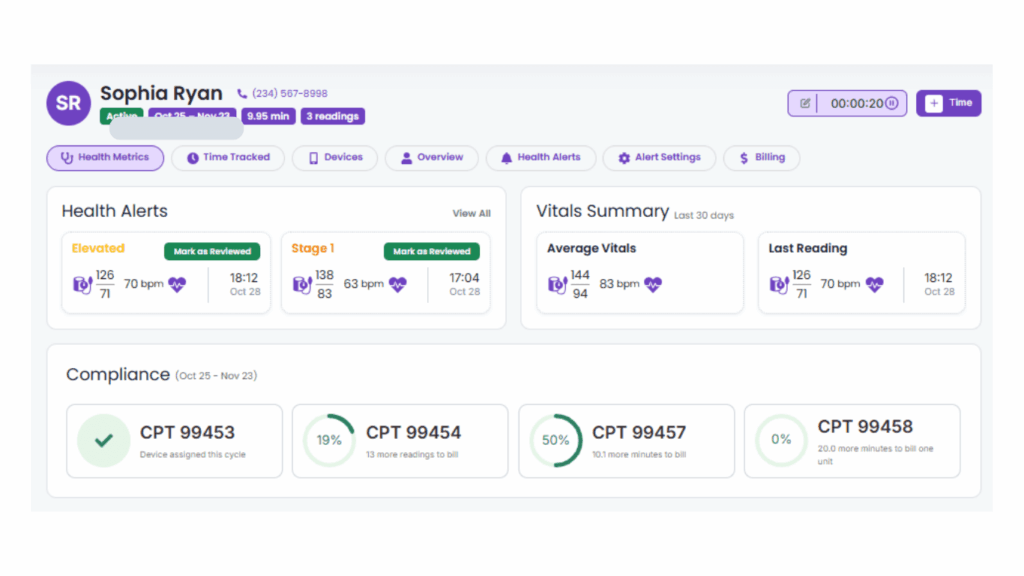
CandiHealth’s system operates on a principle of constant connectivity. Its cellular blood pressure devices transmit readings instantly, day or night, with no need for apps, Wi-Fi, or patient syncing.
Every reading goes directly to the provider dashboard, where automated alerts highlight any abnormal values. This means that even without external monitoring staff, clinics still receive instant notifications the moment a patient’s data crosses a critical threshold.
Clinics Stay in Control
Outsourced monitoring models can separate clinicians from their patients. CandiHealth reverses that. By sending alerts directly to the care team, it ensures that decisions stay with the people who know the patient best.
Each clinic defines how it handles alerts — through in-house nurses, rotating on-call staff, or the primary physician. There’s no middle layer, no delay in communication, and no extra cost for overnight staffing.
Speed Over Staffing
In CandiHealth’s model, the alert goes straight to the provider’s dashboard in real time, often within seconds of the reading. The clinic can act immediately, contact the patient if needed, and document every step inside the same system.
That responsiveness delivers the same practical benefit of continuous monitoring — without outsourcing oversight or patient data.
Conclusion: Choosing the Right RPM Model for Continuous Care
The idea of 24/7 clinician support has become a benchmark for remote patient monitoring, but in practice, it’s not the only path to reliable, continuous care.
Vendors like AccuHealth have set the standard for round-the-clock, clinician-led oversight, offering complete outsourced coverage for high-risk populations. Meanwhile, platforms such as CandiHealth represent a newer direction — one where clinics retain control, avoid outsourcing, and still stay constantly connected to patient data through always-active monitoring technology.
The distinction comes down to method, not intention. Both models aim to keep patients safer, prevent emergencies, and reduce hospitalizations. Clinics choosing an RPM partner should look beyond the term “24/7” and ask: How quickly will we know when something changes, and who will act on that information?
The answer to that question — not the staffing model alone — defines the quality of remote care.
For practices seeking real-time monitoring and direct provider control, CandiHealth offers an approach that turns technology into quiet, reliable continuity: always connected, always aware, and always within the clinic’s reach.
Related Articles
Quick Guide to CandiHealth Remote Patient Monitoring Platform
FAQs: 24/7 Clinician Support and Remote Patient Monitoring
What are remote patient monitoring services?
Remote Patient Monitoring (RPM) services use digital devices to track patients’ vital signs — such as blood pressure, glucose levels, or oxygen saturation — and send this data to healthcare providers for review. The goal is to improve follow-up care and reduce hospital visits.
Which device is commonly used in remote patient monitoring?
Common RPM devices include blood pressure monitors, pulse oximeters, weight scales, and glucose meters. These tools automatically transmit readings to the clinic’s monitoring system or provider dashboard.
Which remote patient monitoring tools can patients use to track physical activity?
Wearables such as Fitbit, Apple Watch, and Garmin can record heart rate, steps, and physical activity levels. While these tools are not always part of formal RPM billing programs, they complement RPM data by showing daily activity trends that impact health outcomes.
What are remote therapeutic monitoring (RTM) treatment management services?
RTM services focus on monitoring therapy adherence and symptoms, not vital signs. They help providers track how patients use prescribed treatments, such as physical therapy exercises or inhaler use. Unlike RPM, RTM covers non-physiologic data and can be billed under separate CPT codes (98975–98981).
Do all RPM services include 24/7 clinician support?
No. Most remote patient monitoring (RPM) platforms collect data but don’t provide around-the-clock clinician oversight. Only a few vendors, such as AccuHealth, publicly confirm 24/7/365 clinical monitoring. Others rely on a clinic’s own team to handle alerts during working hours or through automated notifications.
How does 24/7 clinician support differ from real-time alerts?
24/7 clinician support involves human medical staff reviewing patient readings continuously. Real-time alerts, on the other hand, use connected devices to send immediate notifications to providers. Platforms like CandiHealth offer real-time alerts so clinics can respond instantly, even without outsourced clinician teams.
Is 24/7 clinician monitoring necessary for every RPM program?
Not always. It depends on patient risk levels and clinic workflow. For example, hypertension programs can operate effectively with real-time alerts and in-house review rather than third-party monitoring. Clinics managing post-discharge or cardiac patients may benefit more from continuous clinician coverage.
Does Medicare or insurance require 24/7 clinician availability for RPM billing?
No. CMS billing guidelines for codes like 99453, 99454, 99457, and 99458 require timely review and communication, not necessarily 24/7 human staffing. Clinics must demonstrate consistent data review and patient interaction, which can be achieved through scheduled monitoring or automated systems.
What’s the advantage of keeping monitoring in-house rather than outsourcing?
In-house models give providers control and continuity. They can interpret readings in context, maintain direct communication with patients, and avoid additional outsourcing fees. Real-time technology platforms like CandiHealth make this possible by ensuring data flows continuously to the clinic dashboard.